Elemental Type

Air, Fire, Water and Earth

UNDERSTANDING YOUR ELEMENTAL BALANCE

Your Elemental Balance is based on concepts that have stood the test of time for thousands of years. They are very much alive today in the practice of Traditional Chinese Medicine, Ayurvedic Medicine (the traditional natural medical system of India) and Unani, or Greek, Medicine such as was practiced by Hippocrates. We utilize and describe these concepts in a way that is understandable in the modern world, and at the same time helpful to you. Our goal is to give you knowledge that can help you understand yourself better, and live your life in a healthier and happier way.

Your physical structure gives clues as to the inherent balance of Elements in the natural phenomenon that is your body. When reading through, bear in mind that all of the Elements are working together in you, and the extent to which the descriptions ring true depends on many factors, such as your upbringing, the degree of prominence of the element described, and current state of health. Each one is described in isolation so that you can see its tendencies, but it’s rare for all of the qualities of a single element to dominate completely in the physical or mental-emotional makeup. You’re more of a stew, with each ingredient appearing in greater or lesser degree depending on your state of balance. Understanding these concepts fully requires that you remember that the body and its workings are not considered separate in any way from the rest of the natural world, and the properties of the Elements in nature hold true for their properties in shaping your body and governing its functions. Your inherent balance, or Elemental Type, guides your doctor in recommending foods, supplements, therapies and a lifestyle that help you attain and maintain that elusive balance that results in abundant good health.

These concepts, as we are using them, stand on four pillars:
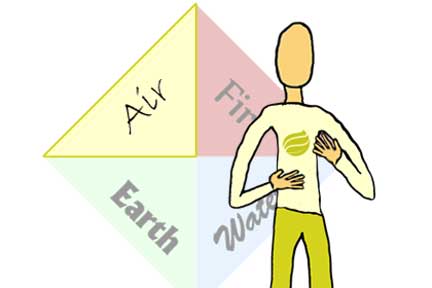
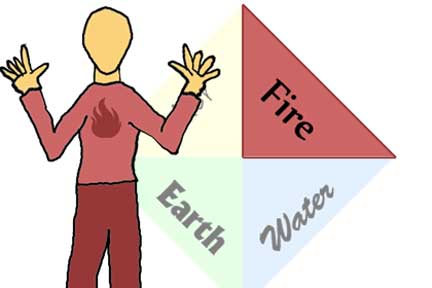
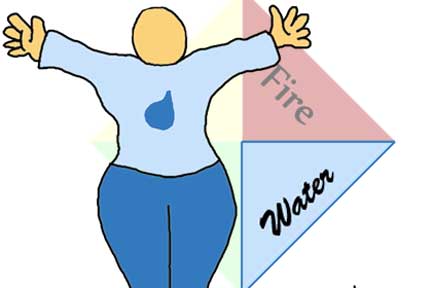
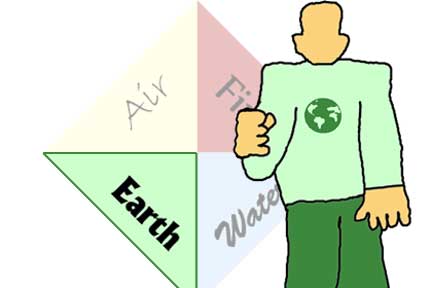
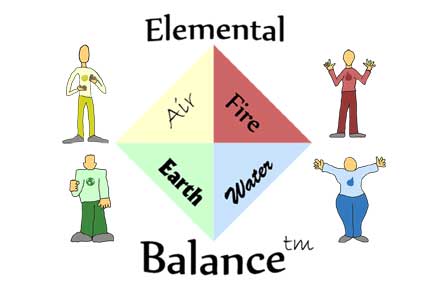
1) The Four Elements – The elements Air, Fire, Water and Earth refer to much more than the familiar phenomena that these words typically describe in common usage. They are rather four basic properties found throughout all of nature, as described in different ways in many cultures around the world. Don’t take them literally; think of them as metaphors to describe basic principles within all of us. For our purposes, Air is not limited to the gas we breathe, but is also both the space that is occupied by the world, and the force (think wind) that impels movement. Fire is the principle behind all transformation, besides being the source of all light and heat. Water is all things fluid, but is also the glue that binds and holds things together. Earth is found wherever there is solid matter and structure.

2) Balance – Health is seen as a state of harmonious balance both within the individual and between the individual and the environment. As both the individual and the environment constantly change, balance is an ever-moving target that is continually sought, and impossible to hold. A friend who pilots small airplanes gives an excellent example of this. He relates that if he is cleared to fly at a certain elevation, say 8,000 feet, he finds that he can rarely get his altimeter to read exactly 8,000 for any length of time. The currents in which he is flying constantly change in wind direction and velocity, barometric pressure, temperature, humidity and so on. He continually shifts position without even noticing it. Your state of balance is similarly affected by the currents of your life. It is affected by food and drink, thoughts and emotions, activities and rest, weather and climate, and even the type of soil and rocks in your neighborhood.

3) Holistic Science – The observations of ancient scientists were organized according to the principle that the universe is an essentially indivisible unity that appears to be composed of many parts, all of which can exist only in relationship to each other. The parts are seen to be inseparably connected in a dynamic web such that all continually interact. Our modern scientific ecological concepts, which recognize that slight changes to any part of a natural system effect all other parts of the system, are beginning to restore this sense of unity. In holistic science, the processes that are seen to occur outside of the body in the natural world are assumed to be similar in character to those that occur inside of the body.

This concept of unity may seem foreign to us at first glance, but is quite rational and based on careful observation. It can be easily understood if we think about it a little. Our current habit of thought, drilled into us early on in our education and reinforced daily since, tells us that we humans are separate objects, each bordered by the barrier of our skin. But are we really separate? Is our skin really a barrier? If we could see our skin on the microscopic level, we would see that it is continually being shed away from our bodies into the environment. The skin seen this way is not a fixed thing, but more a continually regenerating process. Additionally, the microscopic view would reveal that the surface of the skin is teeming with bacteria, without which the skin would deteriorate. There are also several pounds of bacteria distributed throughout your colon, without which you couldn’t properly digest your food. You couldn’t get along without them. Are the bacteria “you” or “other”? Furthermore, the skin is not really a barrier at all, although it does conveniently hold your insides in. Modern pharmaceutical companies take advantage of this fact with drugs delivered through “patches” affixed to the skin in such a way that the drug slowly seeps into the body. We take advantage of the skin’s permeability with the use of the fango and German Footbath, both of which draw toxins from the inside through the skin to the outside.

Rather than seeing yourself as a separate, independent thing, you can as easily see yourself as a medium of exchange with the environment on every level of your being. This is actually a more accurate reflection of how things are. You cannot exist for a moment in the absence of your environment. You continually take in Air, along with food and drink, and expel wastes of various sorts back into the surroundings. Your mind and emotions also continually exchange with your environment, as you repeatedly take in and release words, feelings, facial expressions, and other cues. If you think for a moment, how you feel inside usually depends on who you’re with and what you’re doing. It may also fluctuate with the weather, season, time of day, and a whole host of other factors. Seen in this way, holism isn’t romantic or mystical, but rather an accurate scientific assessment that places us in a correct relationship with our surroundings.

4) Dynamism – Holistic science holds that the entire universe is in a constant state of flux. What appear to be stable objects exist only in time, and change moment to moment depending on surrounding conditions. If you think about it, where will the computer monitor into whose screen you are now staring be in a few years? All things begin to deteriorate the moment they are created. Quantum physics confirms that on the molecular level all objects are a veritable beehive of activity, and atoms and molecules are continually being propelled into the atmosphere, or rubbing off onto other objects. For our purposes, dynamism signifies that your body is in a constant state of flux as well, and is constantly seeking to adapt to ever-changing conditions.